
Iodine Deficiency: Symptoms, Causes, Goitre, Hypothyroidism, Treatment and Prevention — The Complete Doctor’s Guide
The world’s most preventable cause of intellectual disability and why a pinch of salt could have stopped it.
✍️ Written and Reviewed by: Prof. Dr. Qazi Taqweemulhaq, FCPS Medicine. Professor of Medicine, Women Medical and Dental College, Abbottabad, Pakistan. Consultant Physician with 32 Years of Clinical Experience.📅 Last Updated: June 2026 | References: NIH ODS, NCBI StatPearls, Endocrine Society 2024, NEJM VITAL Trial, Cleveland Clinic, Merck Manual
⚡ Quick Answer: Iodine deficiency affects over 1.8 billion people across 130 countries, the world’s leading preventable cause of intellectual disability. It causes goitre (thyroid enlargement), hypothyroidism, and in severe maternal deficiency during pregnancy, cretinism: irreversible profound intellectual disability, deafness, and spasticity in the newborn. Diagnosis: urinary iodine concentration. Treatment: iodised salt, dietary optimisation, and potassium iodide supplements. Prevention is entirely achievable, universal salt iodisation costs less than $0.10 per person per year.
✅ KEY TAKEAWAYS — Iodine Deficiency |
• Iodine deficiency is the world’s leading preventable cause of intellectual disability, affecting over 1.8 billion people across 130 countries |
• The thyroid gland is the only organ that requires iodine. It needs it to make T3 and T4 hormones that control the body’s entire metabolic rate |
• Goitre (visible thyroid enlargement) is the earliest and most recognisable sign but cognitive impairment begins before goitre appears |
• The most devastating consequence is cretinism, irreversible profound intellectual disability, deafness, and spasticity from severe maternal iodine deficiency during pregnancy |
• Iodised salt is the world’s most cost-effective public health intervention costing less than $0.10 per person per year to implement |
A Pinch of Salt Could Have Changed Everything. For Millions of Children, Nobody Offered It.
I want you to think about the most expensive medical intervention you can imagine. Brain surgery. Neonatal intensive care. Decades of special education and supported living. Lifelong care expenses.
Now consider that every one of those costs, every year of suffering could have been prevented by adding iodine to table salt.
A process that costs less than ten cents per person per year.
Iodine deficiency is the world’s leading preventable cause of intellectual disability. Not the most dramatic. Not the rarest. The leading preventable cause.
In areas of severe deficiency, children are born with cretinism—a condition of profound irreversible intellectual disability, deafness, and physical disability caused entirely by their mother’s iodine deficiency during pregnancy.
These children will never read. Many will never speak. And every single case was preventable.
Incidence
Iodine deficiency affects over 1.8 billion people across 130 countries. More than 29% of the world’s population lives in areas of iodine-poor soil.
In South Asia including Pakistan, Afghanistan, Nepal, and mountainous regions of India, iodine deficiency remains a significant public health problem, particularly in the Himalayan regions.
In my years of clinical practice, I have seen the full spectrum of iodine deficiency, from the patient who comes with a visible goitre, to the hypothyroid woman who has been fatigued for years, to the child who never reached his intellectual potential.
This article tells the complete clinical story of iodine deficiency, from the first goitre to the most severe consequences.
🏥 From My Clinic: A 34-year-old schoolteacher from a rural district came to my clinic with a neck swelling she had noticed growing gradually over three years. She had assumed it was ‘just fat.’ On examination: a visible, smooth, diffusely enlarged thyroid gland, a grade 2 goitre. TSH was elevated at 12.5 mIU/L. Free T4 was low. She was clinically hypothyroid. She had never used iodised salt. Her family purchased loose, unprocessed salt from a local market. She had two children at home, both showing learning difficulties at school. All three family members were placed on supplementation. The schoolteacher’s thyroid normalised within six months. Her children’s school performance, I cannot say with certainty, may have been permanently affected by the years of insufficient iodine during their developmental years
What Is Iodine and What Does It Do?
Iodine is a trace element whose only known function in the human body is the synthesis of thyroid hormones. Unlike most minerals, it has no role in enzymatic reactions, bone structure, or cellular energy production. It exists solely to make thyroxine (T4) and triiodothyronine (T3).
This single function makes iodine indispensable because thyroid hormones regulate the metabolic rate of every cell in the body. They control:
- Basal metabolic rate, how fast the body burns energy at rest
- Core body temperature
- Heart rate and cardiac output
- Protein synthesis and growth
- Gut motility
- Brain development, critically, during foetal life and the first three years after birth
How Thyroid Hormones Are Made, The Iodine Pathway
- Step 1, Iodine absorption: dietary iodine is absorbed in the gut as iodide (I⁻) and enters the bloodstream
- Step 2, Thyroid uptake: the sodium-iodide symporter (NIS) actively transports iodide into thyroid follicular cells against a concentration gradient, concentrating it up to 25–50× plasma levels
- Step 3, Organification: thyroid peroxidase (TPO) oxidises iodide to iodine, which then binds to tyrosine residues on thyroglobulin protein
- Step 4, Coupling: two iodinated tyrosines are coupled to form T4 (two DIT residues) or T3 (one MIT + one DIT)
- Step 5, Release: TSH from the pituitary stimulates proteolysis of thyroglobulin, releasing T4 and T3 into the bloodstream
When iodine is insufficient, Steps 3 and 4 fail. The pituitary detects low T4, releases more TSH, which drives compensatory thyroid hypertrophy, producing the goitre. If the goitre still cannot produce enough hormone, hypothyroidism develops.
💡 Clinical Insight: Antithyroid drugs (propylthiouracil, methimazole) work by blocking thyroid peroxidase, the same enzyme that organifies iodine. Understanding the synthesis pathway explains both how deficiency causes disease and how medications work.
The Iodine Deficiency Disorder (IDD) Spectrum – From Goitre to Cretinism
Iodine deficiency is not a single disease. It is a spectrum of disorders (IDDs) whose severity depends on the degree of deficiency, the life stage affected, and the duration of inadequate intake. The WHO classifies iodine status by median urinary iodine concentration in population surveys:
Severity | Median Urinary Iodine | Population Effect | Clinical Features |
Mild deficiency | 50–99 µg/L | Schoolchildren: slight reduction in IQ; goitre in 5–20% | Goitre; mild hypothyroidism; possible mild cognitive impairment |
Moderate deficiency | 20–49 µg/L | Goitre in 20–30%; hypothyroidism more common | Goitre; clinical hypothyroidism; reduced IQ of 10–15 points; learning difficulties |
Severe deficiency | < 20 µg/L | Endemic goitre; cretinism; significant perinatal mortality | Goitre; myxoedema; cretinism in offspring of deficient mothers; deaf-mutism; spasticity |
Optimal (WHO) | 100–199 µg/L | No goitre; normal thyroid function; normal cognitive development | No iodine deficiency disorders |
Excess (risk) | ≥ 300 µg/L | Risk of iodine-induced hyperthyroidism; autoimmune thyroiditis | Hyperthyroidism (especially in previously deficient areas); Hashimoto’s thyroiditis |
Table 1. WHO iodine deficiency severity classification and population effects. Sources: WHO; NCBI Bookshelf; ScienceDirect; PMC GBD 2021
Cretinism, The Most Devastating IDD
Cretinism is the most devastating consequence of severe maternal iodine deficiency during pregnancy.
It occurs when the developing fetal brain is deprived of thyroid hormones during the critical first and second trimesters.
Two clinical forms exist:
1. Neurological Cretinism
- Most common in South America, South Pacific, and parts of South Asia
- Dominated by profound intellectual disability (IQ often < 50)
- Deaf-mutism, inability to hear or speak
- Spastic diplegia, spasticity of the lower limbs, causing an abnormal gait
- Squint (strabismus)
- Normal or near-normal thyroid function in the child the damage is purely neurological, from intrauterine deprivation
2. Myxoedematous Cretinism
- More prevalent in Central Africa
- Features of severe postnatal hypothyroidism: coarse face, dry skin, hoarse voice, constipation
- Severe growth retardation and short stature
- Less severe intellectual disability than neurological form
- Responds partially to thyroid hormone replacement if started early
⚠️ Warning: Cretinism is entirely and permanently irreversible. No treatment can restore the intellectual capacity destroyed by iodine deficiency during foetal brain development. The only strategy is prevention, ensuring every pregnant woman has adequate iodine BEFORE and DURING pregnancy
The Cognitive Cost of Mild-to-Moderate Deficiency
Even mild iodine deficiency, insufficient to cause goitre or hypothyroidism, reduces the IQ of affected children by an estimated 10–15 points on average. At a population level, this is catastrophic: an entire generation performing below their intellectual potential, not because of genetics or educational opportunity, but because of a missing trace element in their diet.
💡 Clinical Insight: The intellectual cost of iodine deficiency is not limited to dramatic cretinism. Across 1.8 billion deficient people, the average IQ reduction represents an immense, invisible, population-wide loss of human potential. It affects school performance, workforce productivity, and economic development for generations.
How Much Iodine Do You Need Per Day?
Requirements increase significantly in pregnancy and lactation. The fetus depends entirely on maternal iodine, and breast milk must provide iodine for the infant’s ongoing brain development.
Life Stage / Group | RDA / AI (µg/day) | Upper Limit (µg/day) |
Infants 0–6 months | 110 µg (AI) | Not established |
Infants 7–12 months | 130 µg (AI) | Not established |
Children 1–8 years | 90 µg | 200–300 µg |
Children 9–13 years | 120 µg | 600 µg |
Teens 14–18 years | 150 µg | 900 µg |
Adults ≥19 years | 150 µg | 1,100 µg |
Pregnant women | 220 µg | 1,100 µg |
Lactating women | 290 µg | 1,100 µg |
Table 2. Iodine RDA and Tolerable Upper Intake Levels. Source: NIH ODS; WHO
⚠️ Warning: In pregnancy, the recommendation of 220 µg/day is the minimum. Many leading authorities including the American Thyroid Association, recommend up to 250 µg/day for pregnant women in iodine-deficient regions. Use potassium iodide supplements NOT seaweed or kelp, whose iodine content is dangerously unpredictable
Iodine Deficiency Symptoms: From Goitre to Myxoedema
The earlier the deficiency, the more severe and potentially irreversible the consequences.
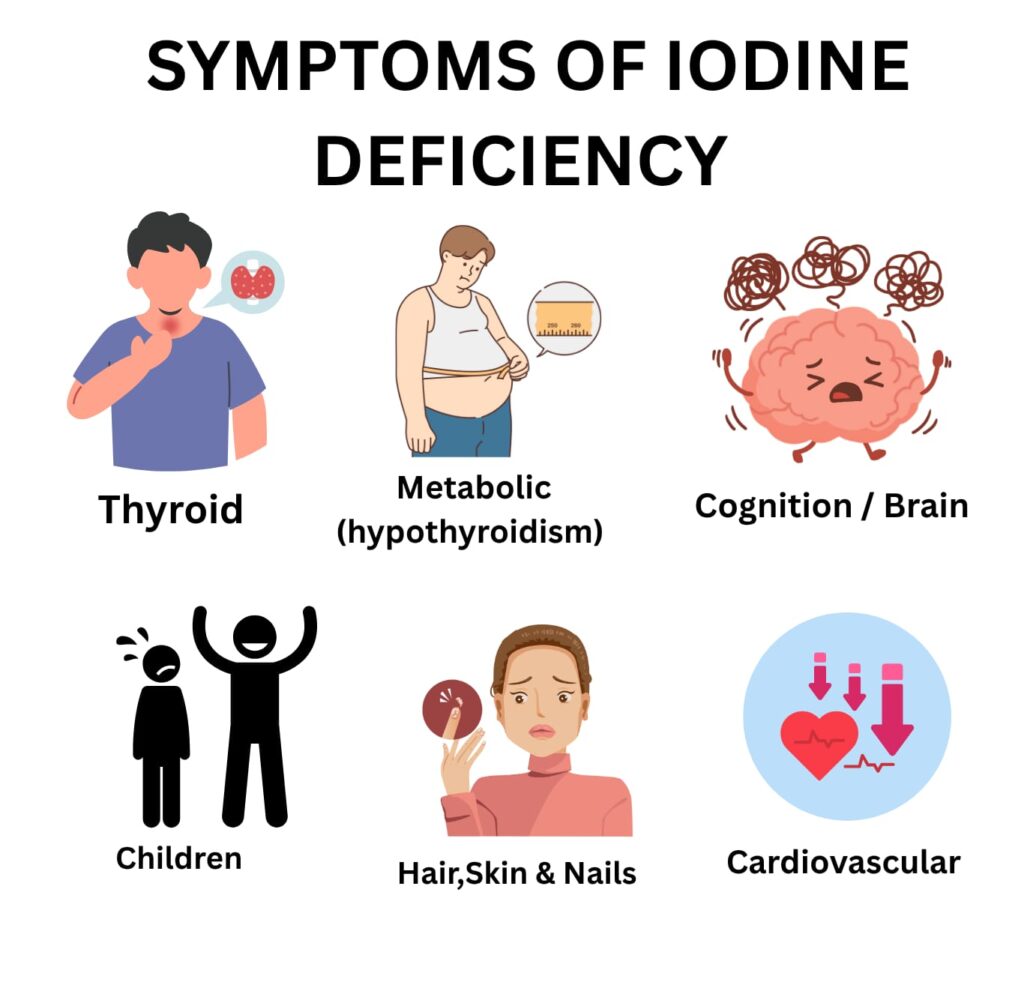
System / Group | Mild–Moderate Deficiency | Severe Deficiency |
Thyroid | Goitre, thyroid gland enlargement visible as neck swelling | Large multinodular goitre; dysphagia; tracheal compression; stridor |
Metabolic (hypothyroidism) | Fatigue, cold intolerance, weight gain, constipation, dry skin | Myxoedema, severe hypothyroidism with puffiness, bradycardia, hypothermia, coma |
Cognition / Brain | Reduced IQ (5–10 points in mild deficiency); brain fog; learning difficulties | Severe intellectual disability; cretinism (IQ < 50 in extreme cases) |
Children | Reduced school performance; impaired hearing; slow growth | Growth retardation; deaf-mutism; spastic diplegia; cretinism |
Pregnancy | Increased miscarriage risk; foetal growth restriction | Stillbirth; perinatal mortality; cretinism in newborn |
Hair, Skin & Nails | Hair thinning, dry skin, brittle nails, same as hypothyroidism | Severe myxoedematous skin changes; periorbital puffiness |
Cardiovascular | Slow heart rate; hypertension in some | Bradycardia; pericardial effusion; heart failure in severe myxoedema |
Table 3. Iodine deficiency symptoms by severity and organ system. Sources: WHO; NIH ODS; Cleveland Clinic; Medscape; NCBI Bookshelf.
Key Symptoms in Clinical Detail
1. Goitre, The Defining Physical Sign
Goitre is the visible or palpable enlargement of the thyroid gland. It is the body’s compensatory response to insufficient iodine, the thyroid enlarges in an attempt to trap more iodine and produce more hormone. WHO grading:
- Grade 0: no palpable or visible goitre, normal.
- Grade 1: goitre palpable but not visible with neck in normal position
- Grade 2: goitre visible with neck in normal position, diagnosis can be made visually.
A goitre prevalence of 5% or more in a population classifies the area as endemic for iodine deficiency, a public health threshold requiring immediate intervention.
Large goitres cause compressive symptoms:
- Dysphagia, difficulty swallowing.
- Hoarse voice, recurrent laryngeal nerve compression.
- Stridor, tracheal compression in massive goitre.
- Visible neck swelling, cosmetically and psychologically distressing
💡 Clinical Insight: Goitre in a mountainous region of Pakistan should be assumed to be iodine deficiency until proven otherwise. The Himalayan foothills, FATA, Gilgit-Baltistan, and parts of KPK are historically endemic regions. A large community goitre survey in any of these areas would almost certainly reveal a prevalence well above the 5% endemic threshold
2. Hypothyroidism: When the Thyroid Gives Up
When compensatory goitre fails to produce enough thyroid hormone, hypothyroidism develops. Symptoms are the classic picture of thyroid failure:
- Fatigue and lethargy, the most universal complaint.
- Weight gain, despite no change in diet.
- Cold intolerance, feeling cold when others are warm.
- Constipation and slowed gut motility.
- Dry skin, coarse hair, brittle nails
- Slow heart rate (bradycardia)
- Heavy or irregular menstrual periods in women
- Depression and brain fog, impaired neurotransmitter synthesis
- Elevated cholesterol, reduced hepatic LDL receptor activity
💡 Clinical Insight: Hypothyroidism from iodine deficiency is clinically indistinguishable from autoimmune hypothyroidism (Hashimoto’s thyroiditis). The key discriminator: TSH elevated, T4 low in both. Check urinary iodine and thyroid antibodies (anti-TPO) to differentiate. In iodine deficiency, antibodies are negative and urinary iodine is low
3. Myxoedema, Severe Hypothyroidism
Myxoedema is the clinical syndrome of severe, long-standing hypothyroidism:
- Characteristic non-pitting oedema of the skin, particularly periorbital (puffy eyelids) and pretibial
- Coarse, dry, yellowish skin
- Macroglossia, enlarged tongue
- Hoarse, deep voice
- Profound bradycardia and hypothermia
- Pericardial effusion, fluid around the heart
- Myxoedema coma, life-threatening emergency with severe hypothermia, hypotension, and reduced consciousness
What Causes Iodine Deficiency? Every Cause Explained
Cause | Specific Cause | Mechanism / Note |
Geoenvironmental | Iodine-poor soil, mountainous and inland regions | Most fundamental cause. Himalayan, Andean, Central African, and inland Asian regions have iodine-depleted soil from glaciation and leaching. Crops grown in this soil are iodine-poor. |
Dietary | Low seafood, dairy, and iodised salt intake | Populations relying on locally grown plant foods in iodine-poor regions have near-zero dietary iodine unless fortified foods or seafood are consumed. |
Goitrogens | Cruciferous vegetables, cassava, soya, millet, sweet potato, lima beans | Goitrogens block thyroid iodine uptake or interfere with thyroid hormone synthesis. Clinically significant only when consumed in very large quantities alongside iodine deficiency. Cooking reduces goitrogenic activity. |
Drug-induced | Amiodarone (high iodine load), lithium, perchlorate, thiocyanates (smoking) | Lithium blocks thyroid hormone release. Amiodarone contains 37% iodine by weight. Can cause either hypothyroidism or hyperthyroidism. Smoking (thiocyanates) competes with iodine uptake in the thyroid. |
Pregnancy | Increased renal iodine clearance + foetal demand | Pregnancy dramatically increases iodine demand. The fetus depends entirely on maternal iodine. Renal clearance of iodine increases by 30–50% in pregnancy. Marginal pre-pregnancy iodine status leads to deficiency. |
Vegan / plant-based diet | No seafood, no dairy, non-iodised salt | Plant foods contain minimal iodine. Vegans who do not use iodised salt or supplements are at high risk. Studies confirm significantly lower urinary iodine in vegans. |
Lapsed fortification | Countries where iodised salt programmes have lapsed | Recurrence of iodine deficiency and new cases of cretinism have been documented in countries where salt iodisation programmes lost funding or compliance. |
Table 4. Complete causes of iodine deficiency. Sources: WHO; NIH ODS; NCBI Bookshelf; PMC.
Goitrogens – The Foods That Interfere With Iodine
Goitrogens are natural compounds in certain foods that interfere with thyroid iodine uptake or hormone synthesis. The main dietary goitrogens:
- Glucosinolates in cruciferous vegetables: cabbage, broccoli, cauliflower, Brussels sprouts, kale, breakdown products (isothiocyanates) block iodine organification
- Cyanogenic glycosides: cassava, sorghum, sweet potato and lima beans converted to thiocyanate in the body, which competes with iodine for thyroid uptake
- Soya isoflavones: inhibit thyroid peroxidase activity
Goitrogens are clinically significant only when consumed in very large quantities alongside iodine deficiency.
A well-iodized person eating normal amounts of broccoli is at zero risk.
Goitrogens become relevant when they are dietary staples in communities already consuming insufficient iodine. The classic example being cassava-dependent populations in Central Africa. Cooking significantly reduces goitrogenic activity.
How Is Iodine Deficiency Diagnosed?
Iodine status is assessed differently at the population level (surveys) and the individual level (clinical testing). The two approaches use different measurements and serve different purposes.
Population Assessment, Urinary Iodine Concentration (UIC)
Urinary iodine concentration (UIC) is the standard population-level indicator, because over 90% of dietary iodine is eventually excreted in urine.
UIC reflects recent iodine intake and is measured in random urine samples from a representative sample of schoolchildren.
- WHO optimal: median UIC 100–199 µg/L in schoolchildren; 150–249 µg/L in pregnant women
- Deficient populations: median UIC < 100 µg/L
- At-risk: median UIC < 50 µg/L — requires urgent intervention
Individual Clinical Assessment
- Serum TSH: most sensitive marker of thyroid function. Elevated TSH (> 4.5 mIU/L) indicates hypothyroidism from any cause — including iodine deficiency
- Free T4 (FT4): low in hypothyroidism. Combined with elevated TSH = primary hypothyroidism
- Thyroid antibodies (anti-TPO, anti-thyroglobulin): elevated in Hashimoto’s thyroiditis; typically negative in pure iodine deficiency
- Thyroid ultrasound: assesses goitre volume, nodularity, vascularity. Small, diffuse goitres suggest iodine deficiency; large, nodular goitres may require further investigation
- Spot urinary iodine: individual-level test, highly variable due to day-to-day fluctuation. More useful as a trend indicator than a single diagnostic test
💡 Clinical Insight: A low TSH does not rule out iodine deficiency in a patient with a large nodular goitre. Some nodules become autonomously functioning and produce excess thyroid hormone (iodine-induced hyperthyroidism), suppressing TSH. This is the Jod-Basedow phenomenon.It occurs when iodine supplementation is given to patients with pre-existing nodular goitre in previously iodine-deficient areas.
Iodine Deficiency Treatment: Supplementation, Salt, and What Cannot Be Reversed
The most important clinical principle in iodine deficiency treatment: what can be reversed, and what cannot.
Goitre, hypothyroidism, and cognitive impairment from mild deficiency are reversible. Cretinism is not reversible.
This distinction should drive urgency of treatment, especially in pregnant women.
Clinical Scenario | Treatment | Duration & Notes |
Mild dietary deficiency (general population) | Dietary iodine optimisation, iodised salt, dairy, seafood | Ongoing dietary habit change. Recheck urinary iodine after 3 months. |
Moderate deficiency, hypothyroid | Potassium iodide supplementation 150–200 µg/day OR iodised salt if accessible | Goitre may reduce, especially small diffuse goitres of short duration. Large nodular goitres do not regress. |
Pregnancy (iodine deficient) | Iodine supplement 150–250 µg/day PLUS dietary iodine. Target total 220–290 µg/day. | Begin before conception if possible. Do NOT use kelp or seaweed supplements, iodine content is unpredictable. Use potassium iodide. |
Iodine deficiency hypothyroidism | Levothyroxine (T4) replacement if hypothyroid + iodine to correct deficiency | TSH monitoring every 6–12 weeks until stable. Treating iodine deficiency may restore thyroid function over time in mild cases. |
Cretinism | Levothyroxine replacement, early treatment prevents further deterioration | Cretinism is IRREVERSIBLE once established. Treatment prevents worsening but does not restore lost intelligence. Prevention is the only answer. |
Population-level programmes | Universal salt iodisation (USI), 20–40 mg iodine per kg salt | WHO-recommended first-line intervention. Most cost-effective public health intervention in nutrition. Regular monitoring of iodine status required. |
Table 5. Iodine deficiency treatment protocol. Sources: WHO; NIH ODS; Cleveland Clinic; Medscape
Recovery Timeline
What Improves | Timeline After Starting Treatment |
Thyroid hormone levels (TSH, T3, T4) | 2–4 weeks |
Hypothyroid symptoms (fatigue, cold intolerance, brain fog) | 4–8 weeks |
Small diffuse goitre | 3–6 months, may significantly reduce or resolve |
Large nodular goitre | Does NOT regress with iodine alone, may need surgery |
Cognitive improvement (mild deficiency) | Months — partial improvement possible in children |
Cretinism | Does NOT reverse, irreversible brain damage |
Table 6. Recovery and prognosis after iodine deficiency treatment. Source: Clinical experience + WHO; NCBI Bookshelf; Medscape.
The Jod-Basedow Phenomenon, When Iodine Causes Hyperthyroidism
When iodine supplementation is introduced rapidly to a population with longstanding severe iodine deficiency and large nodular goitres, a proportion of patients develop iodine-induced hyperthyroidism, the Jod-Basedow phenomenon:
- Autonomously functioning thyroid nodules which had been producing as much hormone as available iodine allowed, suddenly receive an abundant iodine supply
- They produce excess thyroid hormone, suppressing TSH and causing clinical hyperthyroidism
- Symptoms: palpitations, weight loss, tremor, heat intolerance, anxiety
- Most common in elderly patients with longstanding nodular goitres
- Usually transient, resolves as autonomously functioning nodules are treated
💡 Clinical Insight: This is why iodine supplementation programmes require careful monitoring, particularly in previously severely deficient populations.
The benefit to the vast majority (prevention of cretinism and hypothyroidism) far outweighs the risk of transient iodine-induced hyperthyroidism in a minority of elderly patients with nodular goitres.
Best Dietary Sources of Iodine
Iodine content in food is highly variable and depends critically on the iodine content of the soil and water where food is grown or raised. This variability explains why geographic location is such a powerful determinant of iodine status.
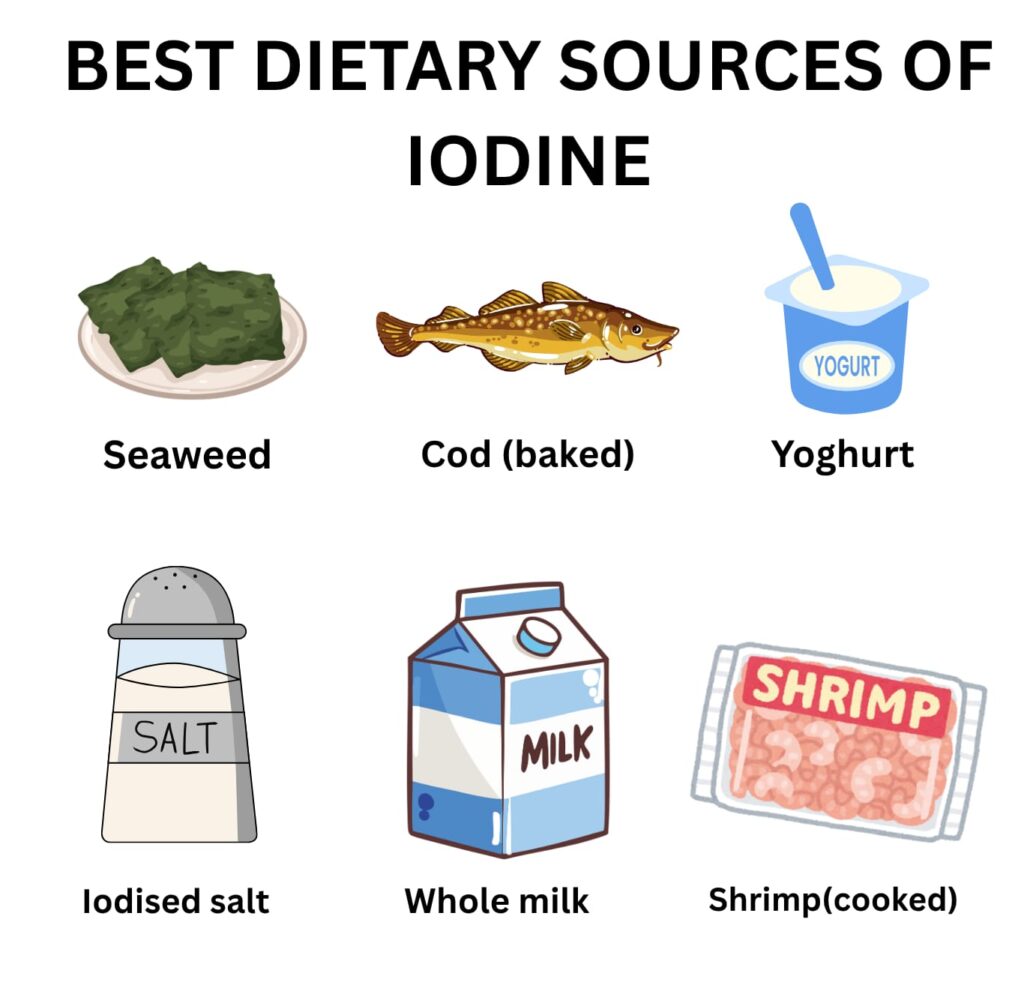
Food Source | Serving Size | Iodine (µg) |
Seaweed (dried, e.g. nori, kelp) | 1 sheet / 7 g | 16–2,984 µg ✦ Highly variable |
Cod (baked) | 85 g (3 oz) | 99 µg |
Plain low-fat yoghurt | 1 cup (245 g) | 75 µg |
Iodised table salt | 1.5 g (¼ tsp) | ~71 µg (varies by country) |
Milk (whole) | 1 cup (240 ml) | 56 µg |
Shrimp (cooked) | 85 g (3 oz) | 35 µg |
Egg (hard-boiled) | 1 large | 26 µg |
Tuna (canned in water) | 85 g (3 oz) | 17 µg |
Cheese (cheddar) | 40 g | 12 µg |
Bread (made with iodate dough conditioner) | 2 slices | Up to 45 µg (check label) |
Table 7. Top dietary sources of iodine. Source: NIH ODS / USDA FoodData Central. Adult RDA = 150 µg/day
🧂 The Iodised Salt Principle: Using ¼ teaspoon of iodised salt daily provides approximately 71 µg of iodine nearly half the adult daily requirement.This simple habit, applied consistently, virtually eliminates dietary iodine deficiency risk. The key: ensure the salt is actually iodised. Loose, unprocessed, or sea salt typically contains negligible iodine
⚠️ Warning: Seaweed (kelp) supplements should NOT be used to treat iodine deficiency in pregnancy. Iodine content in seaweed varies from 16 to nearly 3,000 µg per serving, a 200-fold range. A single serving of dried kelp can deliver 10–20 times the safe upper limit. Use potassium iodide supplements with a stated, reliable dose.
Prevention: Universal Salt Iodisation and Beyond
Universal Salt Iodisation (USI), The World’s Most Effective Nutritional Intervention
Universal salt iodisation adding potassium iodate or iodide to food-grade salt at a concentration of 20–40 mg iodine per kg salt is the WHO-recommended gold standard for eliminating iodine deficiency at the population level. Its credentials:
- Implemented in over 120 countries
- Has reduced goitre rates by 50–80% in previously endemic regions
- Has prevented an estimated tens of millions of cases of cretinism since widespread implementation began
- Costs less than $0.10 per person per year to implement
- One of the greatest public health achievements of the 20th century
Pakistan has a national iodised salt programme. However, coverage remains incomplete, rural and remote areas, particularly in KPK and Balochistan, still rely on unprocessed salt with negligible iodine content. The public health gap is real and ongoing.
Individual Prevention Strategies
- Use iodised salt: check the label. It should state ‘iodised’ or ‘with iodine’. Non-iodised salts (sea salt, pink Himalayan salt, rock salt) contain negligible iodine.
- Eat seafood regularly: 2–3 servings per week of fish, shellfish, or other seafood, the most reliable dietary iodine source
- Include dairy: milk and yoghurt, each serving provides 50–75 µg iodine in countries where dairy is produced using iodine-containing cleaning compounds
- Vegetarians and vegans: at significantly higher risk. Use iodised salt consistently and consider a potassium iodide supplement of 150 µg/day
Prevention in Pregnancy, Non-Negotiable
- Begin iodine supplementation before conception, ideally 3 months prior
- Target total iodine intake: 220–290 µg/day throughout pregnancy and lactation
- Choose a prenatal vitamin that contains iodine. Check the label; many do not
- Use potassium iodide supplements, not kelp or seaweed
- Avoid goitrogenic foods in large quantities during pregnancy
Iodine in Pregnancy, The Most Critical Window in Human Development
No period of life is more sensitive to iodine status than the first and second trimesters of pregnancy.
During weeks 10 through 30, the fetal brain undergoes its most rapid and irreversible phase of development.
The fetus depends entirely on maternal thyroid hormones for this process.
Even mild iodine insufficiency during this window can cause permanent, measurable reductions in cognitive function in the child.
The evidence is unambiguous. A landmark study by Bath et al. found that children born to mothers with urinary iodine below 150 µg/g creatinine during pregnancy had significantly lower verbal IQ, reading accuracy, and reading comprehension at ages 8–9.
They were compared to children of iodine-adequate mothers. These were not extreme cases of deficiency. These were mild-to-moderate insufficiency, entirely common and entirely unrecognised.
Why Pregnancy Dramatically Increases Iodine Demand
- Renal clearance of iodine increases by 30–50% in pregnancy, more iodine is lost in urine
- The foetus requires iodine for its own thyroid hormone production from mid-gestation
- The placenta actively concentrates iodine, competing with the maternal thyroid
- Oestrogen increases thyroid-binding globulin, more T4 is bound and unavailable
- Net result: a woman who was marginally iodine-sufficient before pregnancy becomes significantly deficient during it
Practical Guidance for Pregnant and Breastfeeding Women
- Test urinary iodine at booking if you live in a historically deficient area, follow a vegan diet, or have symptoms of hypothyroidism
- Take a prenatal vitamin containing iodine. Check the label specifically for potassium iodide or potassium iodate
- 150 µg/day potassium iodide supplement on top of dietary intake. The American Thyroid Association recommendation for pregnant women in the USA; appropriate for Pakistan
- Continue iodine supplementation throughout breastfeeding, breast milk is the sole iodine source for the exclusively breastfed infant
- Do NOT use seaweed/kelp supplements, unpredictable and potentially harmful iodine dose
Iodine vs Vitamin A vs Iron Deficiency – How to Tell Them Apart
Feature | Iodine Deficiency | Vitamin A Deficiency | Iron Deficiency |
Primary consequence | Goitre, hypothyroidism, cognitive impairment | Blindness, immune failure | Anaemia, fatigue, cognitive impairment |
Most devastating impact | Cretinism, irreversible intellectual disability | Keratomalacia, irreversible blindness | Child cognitive development, maternal mortality |
Reversible? | Mild-moderate: yes. Cretinism: no. | Early stages: yes. Keratomalacia: no. | Fully reversible with treatment |
Primary prevention | Universal salt iodisation | Supplementation + dietary diversification | Diet + iron supplementation in high-risk groups |
Table 8. Comparative guide — Iodine vs Vitamin A vs Iron deficiency. Source: Clinical experience + WHO; NIH ODS; NCBI Bookshelf.
Frequently Asked Questions About Iodine Deficiency
Related Articles on MedBeaconHub.com
- Nutritional Deficiency Diseases: The Complete Doctor’s Guide
- Vitamin D Deficiency: Symptoms, Causes and Treatment
- Vitamin A Deficiency: Night Blindness and Prevention
- Zinc Deficiency: The Immune Mineral
- Magnesium Deficiency: Symptoms, Causes and Treatment
- Folate Deficiency: The Pregnancy-Critical Vitamin
- Calcium Deficiency: Hypocalcaemia Explained
- Iron Deficiency Anaemia: Symptoms and Treatment
- Vitamin K Deficiency: Bleeding, Newborns and Warfarin
References and Authoritative Sources
- NIH Office of Dietary Supplements — Iodine Fact Sheet for Health Professionals
- NCBI StatPearls — Iodine Deficiency (Updated 2025)
- American Thyroid Association — Iodine Deficiency
- Iodine Global Network — Global Scorecard of Iodine Nutrition 2023
- UNICEF — Iodine Deficiency and Prevention
- Endocrine Society — Clinical Practice Guideline on Thyroid Disease in Pregnancy (Updated 2023)
- PMC — Iodine Status and Thyroid Function During Pregnancy (2024)
- Lancet — Iodine Deficiency in UK Pregnant Women (2020)
- WHO — Assessment of Iodine Deficiency Disorders and Monitoring Their Elimination
- Cleveland Clinic — Iodine Deficiency