Iron Deficiency and Anaemia: Symptoms, Causes, Ferritin Levels, Treatment and Prevention – The Complete Doctor’s Guide
The world’s number one nutritional deficiency, and what every woman, man, and parent needs to know.
✍️ Written and reviewed by: Dr. Qazi Taqweemulhaq, FCPS Medicine. Professor of Medicine, Women Medical and Dental College, Abbottabad, Pakistan. Consultant Physician, 32 Years Clinical Experience
📅 Last Updated: May 2026 | References: WHO, NIH ODS, NCBI StatPearls, AGA 2024, AAFP 2025, HemaSphere 2024, Merck Manual
⚡ Quick Answer: Iron deficiency is the world’s most common nutritional deficiency, affecting 1.27 billion people globally. It’s symptoms include fatigue, pallor, shortness of breath, brain fog, hair loss, brittle nails, and pica. Diagnosis is by serum ferritin. Deficiency is < 45 ng/mL per AGA 2024 guidelines (the old cutoff of 12 ng/mL misses most cases). Treatment is oral ferrous sulphate with Vitamin C; IV iron for malabsorption or non-response. In men and post-menopausal women, iron deficiency demands GI investigation to exclude colorectal cancer.
✅ KEY TAKEAWAYS — Iron Deficiency |
• Iron deficiency is the world’s most common nutritional deficiency, affecting 1.27 billion people globally |
• Iron deficiency WITHOUT anaemia (depleted stores, normal Hb) is common, symptomatic, and frequently missed. Ferritin must be checked |
• Iron deficiency anaemia in a man or post-menopausal woman demands GI investigation, colorectal cancer must be excluded |
• A ferritin of 15 ng/mL is NOT normal . The AGA 2024 cutoff for deficiency is < 45 ng/mL, not the outdated lab reference range |
• Treat to ferritin > 100 ng/mL, not just to a normal haemoglobin. Stopping at Hb normalisation guarantees relapse |
• Vitamin C taken with iron tablets doubles or triples non-haem iron absorption; a free, evidence-based intervention |
She Had Seen Four Doctors. Taken Three Antidepressants. Nobody Had Checked Her Ferritin.
In thirty-two years of medicine, the diagnosis I have been most frustrated to inherit from other doctors is iron deficiency. Not because it is rare. Not because it is complicated. But because the answer was sitting in a ferritin level that nobody had bothered to order.
A 29-year-old primary school teacher came to me looking hollowed out:
- Two years of exhaustion
- hair falling out in handfuls in the shower
- a heart that raced when she climbed a single flight of stairs
- on her third antidepressant but no improvement
Her haemoglobin was 9.2 g/dL. Her ferritin was 4 ng/mL, barely detectable. She had heavy periods and ate almost no red meat. Three months of iron supplementation changed her life. She told me she felt ‘like a human being again’ for the first time in two years.
Her story is not unusual. Iron deficiency affects an estimated 1.27 billion people worldwide, making it the world’s most prevalent nutritional deficiency. Two thirds of all anaemia globally is caused by iron deficiency.
Are any of the following true for you?
- You are a woman in your twenties, thirties, or forties who feels constantly tired
- You have been told your blood count is ‘a bit low’ and left with no further action
- You are pregnant, or planning to be
- You follow a vegetarian or vegan diet
- You are a man with unexplained fatigue or breathlessness that is getting gradually worse
Then this article is written for you.
🏥 From My Clinic: The teacher I described is one of dozens of similar cases I see every year. What they share is a gap between a symptom and the test that would explain it. Fatigue is treated with reassurance. Breathlessness is attributed to being unfit. Hair loss is told to wait and see. Get the test. A ferritin level costs almost nothing and can transform a life.
The CDC estimates that iron deficiency affects approximately 10 million Americans, with pre-menopausal women, pregnant women, and adolescent girls at highest risk. In the European Union, iron deficiency anaemia affects 3 to 5% of adult women in Western Europe and significantly more in Eastern European countries. The American Family Physician 2025 update confirms IDA as the most common nutritional deficiency presenting to primary care physicians in the United States.
What Is Iron and Why Is It So Critical to Human Life?
Iron is an essential trace mineral at the centre of virtually every oxygen-related process in the human body. It is the key component of haemoglobin, the protein inside red blood cells that binds oxygen in the lungs and delivers it to every cell.
Iron’s role extends far beyond haemoglobin. It is also:
- The core of myoglobin, oxygen storage in muscle
- A cofactor for enzymes involved in energy metabolism, DNA synthesis, and immune function
- Required for neurotransmitter production, dopamine and serotonin synthesis both depend on iron
This explains why iron deficiency impairs brain function, immune defence, exercise capacity, and mood. This is not attributed to anaemia, but because iron itself is needed for these functions at the cellular level.
The Iron Economy – How the Body Manages Supply
- Total body iron in an adult: 3,500–4,000 mg (men); 2,300–2,800 mg (women)
- Haemoglobin iron: ~65–70%, the largest pool, inside red blood cells
- Storage iron: ~25% stored as ferritin and haemosiderin in liver, bone marrow, and spleen
- Only 1–2 mg per day needs to be absorbed from diet. Losses from menstruation or GI bleeding can far exceed this.
The body recycles iron with remarkable efficiency. 95% of daily iron needs are met by recycling iron from old red blood cells. Only dietary absorption compensates for losses.
Hepcidin – The Master Regulator of Iron
Hepcidin is the hormone that controls iron absorption and distribution. Made in the liver, it responds to:
- High iron stores → high hepcidin → blocks iron absorption and release from stores
- Low iron stores / anaemia → low hepcidin → opens iron absorption and releases stored iron
- Inflammation → high hepcidin → blocks iron despite low stores (functional iron deficiency)
💡 Clinical Insight: Patients with chronic inflammatory conditions like Crohn’s disease, cancer, heart failure, CKD develop iron deficiency that does not respond to oral iron. The elevated hepcidin blocks gut absorption. These patients need intravenous iron that bypasses the hepcidin block entirely.
The Three Stages of Iron Deficiency – Why ‘Normal Blood Count’ Does Not Mean ‘Normal Iron’
Iron deficiency progresses through three sequential stages before reaching the clinical picture of anaemia. Understanding this progression is vital because Stages 1 and 2 are fully correctable, symptomatic, and frequently missed.
- Stage 1 Iron depletion: Ferritin is reduced but serum iron, transferrin saturation, and haemoglobin remain normal. No anaemia but stores are running low. Symptoms may be subtle. Ferritin is the only abnormal test. Most patients at this stage are told ‘everything is normal.’
- Stage 2 Iron-deficient erythropoiesis: Ferritin is very low. Serum iron falls. TIBC rises. Transferrin saturation drops below 20%. The bone marrow is now making iron-deficient red cells. Haemoglobin may still be normal or borderline. Symptoms worsen; fatigue, brain fog, reduced exercise tolerance, hair loss.
- Stage 3 Iron deficiency anaemia (IDA): Haemoglobin falls below WHO threshold. Red cells become small (microcytic) and pale (hypochromic). All symptoms are now established. This is the stage at which most patients finally present to a doctor, often after months or years at Stages 1 and 2.
💡 Clinical Insight: Treating only Stage 3 (anaemia) is insufficient. The goal is to restore iron stores, ferritin to > 100 ng/mL and not merely normalise haemoglobin. A patient whose Hb reaches 12 g/dL but whose ferritin remains 8 ng/mL will relapse within months. Always treat to ferritin, not just Hb.
Iron Deficiency Symptoms: From Early Warning Signs to Full Anaemia
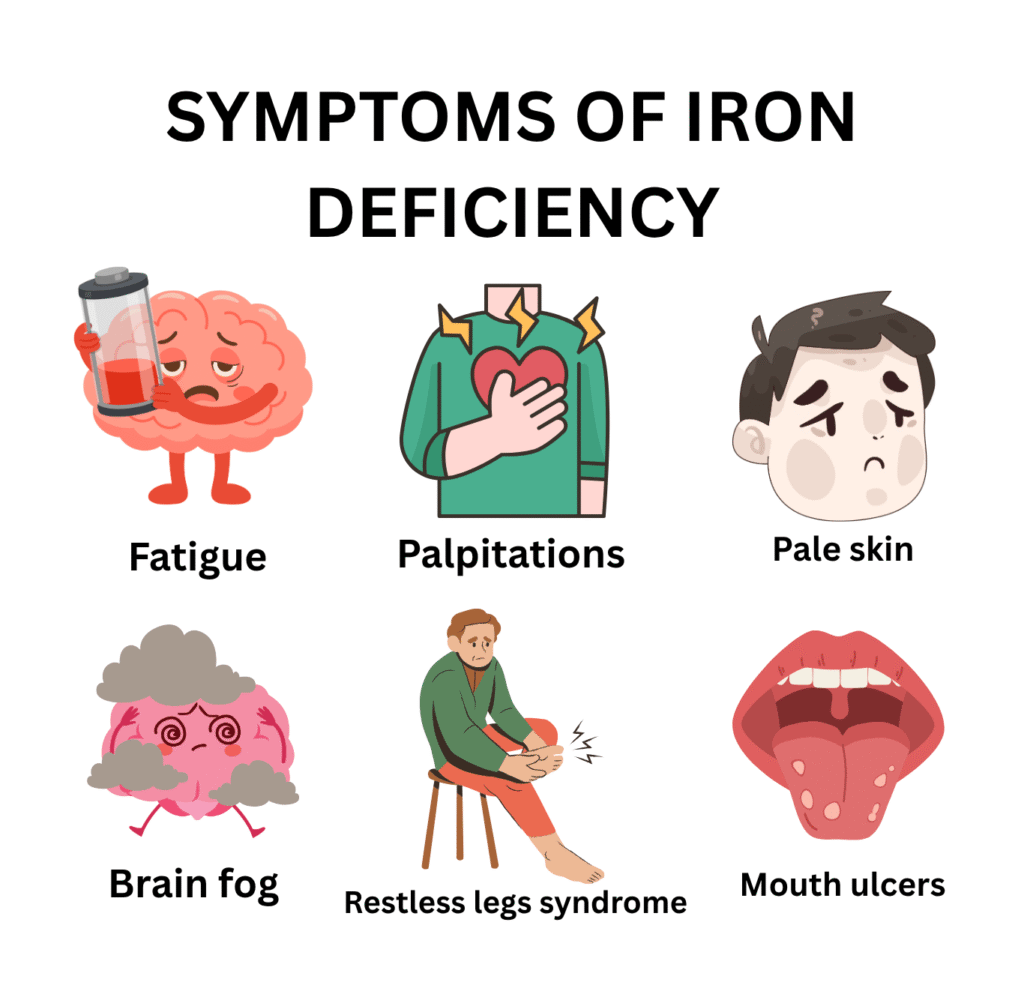
System | Mild–Moderate Iron Deficiency | Severe / Iron Deficiency Anaemia |
General | Fatigue, reduced exercise tolerance, weakness | Profound exhaustion, inability to perform daily tasks, syncope |
Cardiovascular | Palpitations on exertion | Resting tachycardia, dyspnoea at rest, cardiac flow murmur |
Skin, Hair & Nails | Pale skin, brittle nails, hair thinning | Koilonychia (spoon-shaped nails), significant hair loss, pallor of conjunctivae and palmar creases |
Mouth & Tongue | Mouth ulcers, mild glossitis | Angular stomatitis, atrophic glossitis smooth, sore tongue |
Neurological / Cognitive | Brain fog, poor concentration, irritability | Cognitive impairment, headache, tinnitus; impaired child development |
Specific Signs | Restless legs syndrome (RLS), reduced cold tolerance | Pica (craving non-food items; ice, clay, chalk, Plummer-Vinson syndrome |
Pregnancy | Increased maternal fatigue | Preterm birth, low birth weight, postpartum haemorrhage risk, neonatal iron deficiency |
Children | Irritability, reduced play activity | Growth retardation, impaired cognitive development may be irreversible |
Table 1. Iron deficiency and IDA symptoms by severity. Sources: NCBI StatPearls; Cleveland Clinic; Merck Manual.
The Symptoms in Clinical Detail
1. Fatigue, The Universal Symptom
Every patient with iron deficiency is tired. But the nature of this tiredness is distinctive:
- It does not resolve with sleep or rest
- It is cellular fatigue. Muscles and organs cannot get the oxygen they need
- Even mild iron deficiency without anaemia causes measurable reductions in exercise capacity and cognitive performance
2. Pica, The Symptom Nobody Expects
Pica is the compulsive craving and consumption of non-food substances. In iron deficiency:
- Pagophagia (ice eating), the most common form; patients may consume bags of ice daily
- They may eat clay, chalk, dirt, paper, and raw starch other documented forms
- Pica is a recognised marker of severe iron deficiency and resolves with iron replacement
💡 Clinical Insight: I have had multiple patients, mostly young women who sheepishly admitted to eating ice or chalk every day, too embarrassed to mention it to previous doctors. Always ask about pica directly. It is a simple question that leads directly to a diagnosis.
3. Koilonychia, Spoon-Shaped Nails
A pathognomonic sign of longstanding, severe iron deficiency:
- Nails become concave, thin, and brittle, literally spoon-shaped, capable of holding a drop of water
- Develops because iron is required for normal keratin production
- Rarely seen in mild deficiency but unmistakable in advanced cases
4. Restless Legs Syndrome
Iron deficiency is one of the most important and treatable causes of restless legs syndrome (RLS), the overwhelming urge to move the legs at night, accompanied by uncomfortable crawling sensations.
- Iron is required for dopamine synthesis in the brain; dopaminergic dysfunction underlies RLS
- Checking iron studies is mandatory in any patient presenting with RLS
- Iron replacement significantly reduces RLS severity in deficient patients
5. Cognitive Impairment in Children, A Particularly Serious Consequence
Iron deficiency in children, even without overt anaemia, causes measurable impairment of:
- Cognitive development and IQ
- Attention, concentration, and learning capacity
- Language acquisition
During the first two years of life, when brain development is most rapid, iron deficiency can cause irreversible reductions in cognitive performance. This is a public health priority of the highest order.
What Causes Iron Deficiency? Every Cause Explained
Iron deficiency always has a cause. Finding that cause is not optional; it is the most important part of management. Treating iron without finding the source is like refilling a leaking bucket without patching the hole.
Mechanism | Specific Cause | Key Clinical Detail |
Blood loss, gynaecological | Heavy menstrual bleeding (HMB) | Most common cause in pre-menopausal women. Losing > 80 mL blood per cycle constitutes HMB |
Blood loss, GI | Colorectal cancer | IDA in a man or post-menopausal woman = colorectal cancer until proven otherwise. Bidirectional endoscopy mandatory (AGA 2024). |
Blood loss, GI | Peptic ulcer disease | Chronic NSAID use causes gastric erosions and occult GI bleeding, progressively depleting iron |
Blood loss, GI | NSAIDs / aspirin use | High risk of irreversible neurological damage. Urgent treatment, IM injections preferred |
Dietary | Vegetarian / vegan diet | Plant-based diets contain only non-haem iron, absorbed at 2–20% efficiency vs 15–35% for haem iron |
Malabsorption | Coeliac disease | The duodenum — primary iron absorption site — is destroyed by gluten-triggered inflammation. IDA is often the presenting feature of undiagnosed coeliac disease |
Malabsorption | H. pylori infection | It increases gastric pH, reduces ascorbic acid secretion, competes for dietary iron. Eradication improves absorption |
Malabsorption | Bariatric surgery | Bypasses duodenum, primary iron absorption site. Affects up to 50% of post-bypass patients |
Increased demand | Pregnancy | Iron requirement doubles. Blood volume expands 50%; foetal and placental demands are prioritised over maternal stores |
Functional deficiency | Chronic inflammation / CKD / cancer | Elevated hepcidin blocks iron absorption and release from stores. Iron is trapped even when stores are adequate. Oral iron fails, IV iron bypasses the hepcidin block |
Table 2. Complete causes of iron deficiency. Sources: NIH ODS; NCBI StatPearls; AGA 2024; AAFP 2025.
The Colorectal Cancer Rule – Non-Negotiable
Iron deficiency anemia in a man of any age, or in a post-menopausal woman, is colorectal cancer until proven otherwise.
The AGA 2024 Clinical Practice Update recommends bidirectional endoscopy (both colonoscopy and upper GI endoscopy) in men and post-menopausal women presenting with IDA. This is not optional. Colorectal cancer is curable when caught early and fatal when caught late.
⚠️ Warning: Never attribute iron deficiency anemia in a man or post-menopausal woman solely to diet without GI investigation. Occult GI bleeding from cancer, ulcer, or polyp is the most dangerous missed diagnosis in iron deficiency management.
The Coeliac Connection -Always Screen
- The duodenum, where iron is preferentially absorbed is the most severely affected segment in coeliac disease
- IDA is often the presenting feature of undiagnosed coeliac disease
- Screen with anti-tissue transglutaminase IgA antibodies in any patient with unexplained iron deficiency, recommended by AAFP 2025 and British Society of Gastroenterology
How Is Iron Deficiency Diagnosed? Blood Tests and What They Mean
The single most important lesson: normal hemoglobin does NOT exclude iron deficiency. Ferritin must be checked especially in patients with symptoms consistent with Stage 1 or 2 deficiency.
Test | Normal Range | Iron Deficiency | Clinical Note |
Serum Ferritin | 20–300 ng/mL | < 45 ng/mL (AGA 2024) | Best single test for iron stores. AGA 2024 cutoff of 45 ng/mL: 85% sensitivity, 92% specificity. Old cutoff of 12 ng/mL is dangerously insensitive |
Serum Iron | 60–170 µg/dL | Low | Varies widely with recent intake. Less reliable alone |
Transferrin Saturation (TSAT) | 20–50% | < 20% | TSAT = serum iron ÷ TIBC × 100. Useful when ferritin is elevated due to inflammation (functional iron deficiency). |
TIBC | 250–370 µg/dL | Elevated (> 370) | Rises in iron deficiency as transferrin increases to scavenge more iron. Low in anemia of chronic disease. |
Haemoglobin (Hb) | ≥12 g/dL (F); ≥13 g/dL (M) | Below threshold = anaemia | Anemia is a LATE sign. Iron deficiency without anaemia (Stage 1–2) requires ferritin to detect |
MCV | 80–100 fL | < 80 fL (microcytosis) | Microcytosis appears only in established deficiency. Normal MCV does NOT exclude early iron deficiency |
Table 3. Iron studies interpretation. Sources: AGA 2024; AAFP 2025; NIH ODS.
Population Group | Anaemia (Hb below) | Severe Anaemia |
Children 6 months–5 years | 11.0 g/dL | < 7.0 g/dL |
Non-pregnant women ≥15 years | 12.0 g/dL | < 8.0 g/dL |
Pregnant women | 11.0 g/dL | < 7.0 g/dL |
Men ≥15 years | 13.0 g/dL | < 8.0 g/dL |
Table 4. WHO hemoglobin thresholds for anemia by population group. Source: WHO 2011.
The Ferritin Threshold Debate, What the Latest Guidelines Say
- AGA 2024: ferritin < 45 ng/mL, 85% sensitivity, 92% specificity for IDA. This is the threshold I use.
- ASH Draft 2025: ferritin ≤ 20 ng/mL, a stricter threshold under consultation
- When inflammation is present (elevated CRP/ESR): ferritin can be normal or elevated despite deficiency. Use TSAT (< 20%) as an alternative marker.
💡 Clinical Insight: A ferritin of 15 ng/mL in a tired, menstruating woman is iron deficiency, even if the laboratory marks it as ‘normal.’ Treat the patient, not the reference range. The outdated cutoff of 12 ng/mL misses the vast majority of symptomatic iron-deficient women.
Iron Deficiency Treatment: Oral Iron, IV Iron, and When to Transfuse
Treatment has three pillars: replace the iron, restore the stores, and correct the cause. The first without the third guarantees relapse.
Clinical Scenario | First-Line Treatment | Monitoring & Duration |
Mild–moderate deficiency (no anaemia) | Oral ferrous sulphate 200 mg (65 mg elemental) once or twice daily | Recheck ferritin at 3 months; continue until ferritin > 100 µg/L |
Iron deficiency anaemia (mild) | Oral ferrous sulphate 200 mg twice daily with Vitamin C (orange juice) | Hb should rise ≥1 g/dL within 2 weeks (AGA 2024). Continue 3 months after Hb normalises to replenish stores |
IDA, oral intolerance / non-response | IV iron: ferric carboxymaltose, iron sucrose, or ferric derisomaltose. Single infusion often sufficient | Reassess at 3 months. Faster Hb rise than oral; preferred in IBD, post-bariatric, CKD |
IDA in pregnancy | Oral iron first line. IV iron if Hb < 10 g/dL after 28 weeks or oral not tolerated | Monitor Hb every 4 weeks. Continue 3 months postpartum |
Severe anaemia (Hb < 7 g/dL) or haemodynamic compromise | Blood transfusion. 1–2 units packed red cells. IV iron to follow for store replenishment | Transfuse to symptomatic threshold, not to a number. Identify underlying cause urgently. |
Functional iron deficiency (CKD, chronic disease) | IV iron preferred. Oral iron fails because hepcidin blocks absorption | Monitor TSAT and ferritin. Target TSAT > 20%, ferritin > 100 µg/L. |
Table 5. Iron deficiency treatment protocol. Sources: AGA 2024; HemaSphere 2024; AAFP 2025.
Recovery Timeline
What Improves | Timeline After Starting Treatment |
Fatigue and brain fog | 2–4 weeks. Often the earliest improvement |
Haemoglobin rises ≥1 g/dL | 2 weeks (if not, switch to IV iron) |
Haemoglobin fully normalises | 6–8 weeks |
Iron stores (ferritin > 100 ng/mL) | 3 months of continued supplementation after Hb normalises |
Hair loss improves | 3–6 months |
Table 6. Iron deficiency recovery timeline. Source: AGA 2024; clinical experience.
Practical Tips for Maximum Oral Iron Absorption
- Take on an empty stomach: iron absorption is significantly better without food
- Take with Vitamin C: a glass of orange juice doubles or triples non-haem iron absorption
- Alternate-day dosing: emerging evidence suggests every-other-day dosing may result in better total absorption. Daily iron triggers a hepcidin spike that temporarily reduces the next day’s absorption
- GI side effects: if constipation or nausea occurs, switch from ferrous sulphate to ferrous gluconate; gentler, equally effective
When to Use IV Iron
IV iron should not be regarded as a last resort. It is often the right first choice:
- Oral iron not tolerated (GI intolerance)
- Oral iron not absorbed (IBD, coeliac, post-bariatric, functional iron deficiency)
- Rapid correction needed (third-trimester pregnancy, pre-operative optimisation)
- Hb has not risen ≥1 g/dL within 2 weeks of correct oral iron; switch to IV (AGA 2024)
Blood Transfusion – When and When Not
- Transfuse when: Hb < 7 g/dL with haemodynamic compromise; active bleeding with cardiovascular instability
- Never transfuse to a number alone: transfuse to relieve symptoms
- Transfusion does not treat iron deficiency: the iron in transfused cells is recycled, not retained. IV iron must follow to prevent relapse
Best Food Sources of Iron: Haem vs Non-Haem
Not all dietary iron is equal. Understanding the difference between haem and non-haem iron is essential, especially for vegetarians and vegans.
Feature | Haem Iron | Non-Haem Iron |
Source | Meat, poultry, fish, shellfish | Plants, fortified foods, dairy, eggs |
Absorption rate | 15–35% stable regardless of body stores | 2–20%, highly variable; depends on enhancers and inhibitors |
Affected by diet? | Minimally | Strongly. Vitamin C enhances; tea, coffee, calcium inhibit |
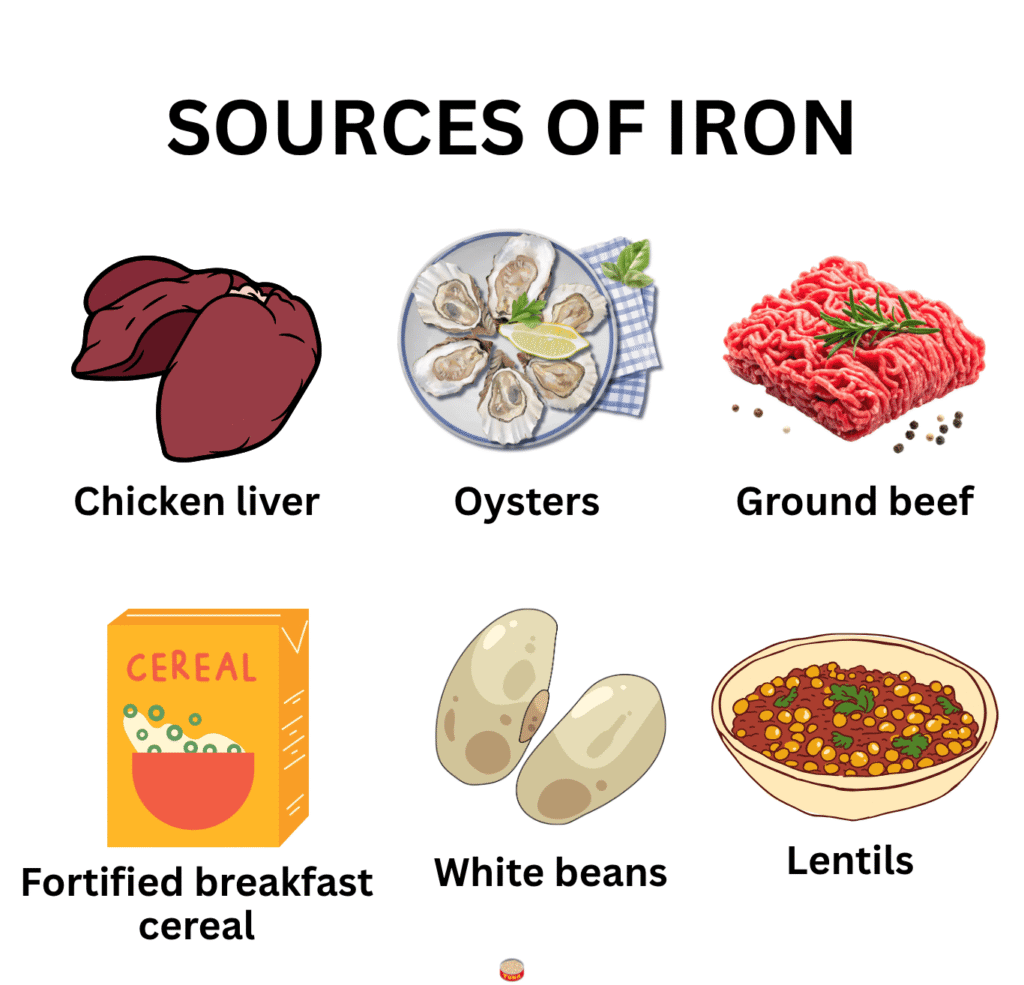
Best food sources | Liver, beef, oysters, dark poultry meat | Lentils, white beans, tofu, spinach, fortified cereal |
Table 7. Haem vs non-haem iron — key differences for dietary planning.
Food Source | Serving | Iron (mg) | Type & Notes |
Chicken liver (cooked) | 85 g | 11.0 mg | Haem, highly bioavailable |
Oysters (cooked) | 85 g | 8.0 mg | Haem, excellent source |
Beef (ground, cooked) | 85 g | 2.2 mg | Haem, well absorbed |
Fortified breakfast cereal | 1 serving | Up to 18 mg | Non-haem, check label; often 100% RDA |
White beans (cooked) | ½ cup | 3.9 mg | Non-haem, take with Vitamin C |
Lentils (cooked) | ½ cup | 3.3 mg | Non-haem, excellent plant source |
Tofu (firm) | ½ cup (126 g) | 3.4 mg | Non-haem |
Spinach (boiled) | ½ cup | 3.2 mg | Non-haem, pair with Vitamin C |
Pumpkin seeds | 28 g (1 oz) | 2.5 mg | Non-haem |
Table 8. Top dietary sources of iron. Source: NIH ODS / USDA FoodData Central. Adult women RDA = 18 mg/day; men = 8 mg/day.
Iron Absorption Enhancers and Inhibitors
Substance | Effect on Iron Absorption | Practical Guidance |
Vitamin C (ascorbic acid) | ENHANCES doubles or triples non-haem absorption | Take iron tablet with glass of orange juice |
Tea and coffee (tannins) | Reduces absorption significantly | Leave 1 hour gap before and after iron-rich meals |
Calcium supplements / dairy | Competes with iron at intestinal absorptive site | Separate calcium and iron supplements by at least 2 hours |
PPIs and antacids | Reduce gastric acid, impairs conversion of Fe³⁺ to absorbable Fe²⁺ | If on long-term PPI, consider IV iron instead of oral |
Phytates (whole grains, legumes) | Bind iron and reduce absorption | Soak, sprout, or ferment to reduce phytate content |
Table 9. Substances that enhance or inhibit iron absorption — practical guidance.
💡 Clinical Insight: In the United States, the habit of drinking coffee or tea with meals is an underappreciated contributor to iron deficiency, particularly in women. Tannins in both coffee and tea powerfully inhibit non-haem iron absorption. The American Gastroenterological Association 2024 guideline confirms that dietary inhibitors of iron absorption are a modifiable cause of deficiency. Leaving even a 30 to 60 minute gap between tea or coffee and iron-rich meals makes a measurable clinical difference.
How to Prevent Iron Deficiency
For the General Population
- Eat iron-rich foods regularly. Red meat 2–3 times per week (if not vegetarian), lentils, beans, fortified cereals, dark leafy vegetables
- Pair plant-based iron sources with Vitamin C at every meal
- Avoid tea and coffee with meals. Leave a gap of at least 1 hour
- Do not take calcium supplements at the same time as iron supplements or iron-rich meals
For Women of Reproductive Age
- Have your ferritin checked annually, not just haemoglobin.
- If you have heavy periods, discuss treatment with your gynaecologist. Tranexamic acid and hormonal options can significantly reduce monthly iron losses.
- Increase dietary iron during and after menstruation when losses are highest.
During Pregnancy
- All pregnant women: recommended 27 mg elemental iron per day from the second trimester
- Check Hb and ferritin at booking, 28 weeks, and 36 weeks
- If Hb < 10 g/dL at or after 28 weeks: consider IV iron for rapid correction before delivery.
- Continue iron supplementation 3 months postpartum.
For Vegetarians and Vegans
- Plan iron intake deliberately and systematically.
- Annual iron studies (ferritin + Hb) as routine monitoring.
- If ferritin falls below 30 ng/mL, discuss supplementation with your doctor.
Iron vs Vitamin B12 vs Vitamin D Deficiency—How to Tell Them Apart
Feature | Iron Deficiency | Vitamin B12 Deficiency | Vitamin D Deficiency |
Global burden | 1.27 billion people | Hundreds of millions | ~1 billion people |
Anaemia type | Microcytic, hypochromic | Megaloblastic (macrocytic) | Not a direct cause |
Key early symptom | Fatigue, pallor, pica | Tingling, numbness | Bone pain, body ache |
Neurological damage? | No | Yes. Irreversible if delayed | Proximal myopathy only |
Key diagnostic test | Serum ferritin | Serum B12 + MMA | Serum 25(OH)D |
Critical rule | In men / post-menopausal women: GI investigation mandatory | Always exclude B12 before treating folate | Order 25(OH)D NOT 1,25(OH)2D. |
Table 10. Comparative guide — Iron vs B12 vs Vitamin D deficiency. Source: Clinical experience + NCBI StatPearls; NIH ODS.
Frequently Asked Questions About Iron Deficiency and Anaemia
Related Articles on MedBeaconHub.com
- Nutritional Deficiency Diseases: A Doctor’s Complete Guide (Pillar Article)
- Vitamin C Deficiency: Why Vitamin C Is Your Best Tool for Iron Absorption
- Vitamin B12 Deficiency: The Other Great Cause of Anaemia
- Folate Deficiency: How It Mimics B12 Deficiency and Why Both Matter
- Zinc Deficiency: The Immune Mineral Often Depleted Alongside Iron
References and Authoritative Sources
- NIH Office of Dietary Supplements — Iron Fact Sheet for Health Professionals
- AGA Clinical Practice Update on Management of Iron Deficiency Anaemia 2024
- AAFP 2025 — Updates in the Management of Iron Deficiency Anaemia
- HemaSphere 2024 — Recommendations for Diagnosis, Treatment and Prevention of IDA
- PMC — Iron Deficiency: Global Trends and Projections 1990–2050 (GBD 2021)
- NCBI StatPearls — Iron Deficiency Anaemia
- WHO — Haemoglobin Concentrations for the Diagnosis of Anaemia
- Merck Manual Professional Edition — Iron Deficiency Anaemia
- Cleveland Clinic — Iron Deficiency Anaemia
- Frontiers in Nutrition 2025 — Ironically Unwell: Anaemia and Iron Deficiency Among Health-Aware Adults