
Vitamin B1 (Thiamine) Deficiency: Beriberi, Wernicke Encephalopathy, Symptoms and Treatment
The vitamin the brain cannot survive without for more than three weeks, and why giving glucose without it first is one of the most dangerous errors in emergency medicine.
✍️ Written and Reviewed by: Prof. Dr. Qazi Taqweemulhaq, FCPS Medicine. Professor of Medicine, Women Medical and Dental College, Abbottabad, Pakistan. Consultant Physician with 32 Years of Clinical Experience. 📅 Last Updated: June 2026 | References: NINIH ODS, NCBI StatPearls (2025), Merck Manual, Cleveland Clinic, NEJM, American Academy of Neurology, WHO
⚡ Quick Answer: Vitamin B1 (Thiamine) deficiency symptoms include beriberi, affecting the cardiovascular system (wet beriberi: high-output heart failure) and, nervous system (dry beriberi: peripheral neuropathy); and Wernicke-Korsakoff syndrome, an acute, potentially fatal brain emergency. The body stores only 30 mg of thiamine. Stores deplete within 2 to 3 weeks on a thiamine-free diet. In the United States, alcohol use disorder is the primary cause. Globally, white rice-based diets remain the most common dietary cause. The single most important clinical rule: give IV thiamine BEFORE any IV glucose in any malnourished or alcohol-dependent patient. Reversing the order precipitates Wernicke encephalopathy and can cause permanent brain damage.
✅ KEY TAKEAWAYS — Vitamin B1 Deficiency |
• Thiamine is required for three critical enzymes in carbohydrate metabolism: pyruvate dehydrogenase, alpha-ketoglutarate dehydrogenase, and transketolase. Without it, glucose cannot be used for energy by the brain, heart, or peripheral nerves |
• The body stores only 30 mg of thiamine. At a daily requirement of 1.1 to 1.2 mg, stores deplete within 2 to 3 weeks of inadequate intake. No other B vitamin depletes this rapidly |
• Wet beriberi causes high-output cardiac failure: the heart pumps faster and harder in a failing attempt to compensate for peripheral vasodilation from thiamine-depleted tissues. This is a medical emergency. |
• Wernicke encephalopathy presents with the classic triad of confusion, ophthalmoplegia (eye movement paralysis), and ataxia. Only one-third of patients present with all three. Do not wait for the complete triad before treating. |
• Giving IV glucose to a thiamine-depleted patient precipitates Wernicke encephalopathy by consuming the last remaining thiamine in metabolic pathways. Thiamine must come first. Always. |
• In the United States, approximately 80,000 people per year develop Wernicke encephalopathy, predominantly from alcohol use disorder. Up to 80% of cases are missed or misdiagnosed during life. |
The Glucose That Caused the Brain Damage
He was 47 years old. He was brought to an emergency department in the hospital after a family member found him confused and unsteady at home. He smelt of alcohol. His blood glucose was 2.4 mmol/L, clinically hypoglycaemic.
The emergency team did what the protocol said. They gave 50 ml of 50% dextrose intravenously. His glucose rose. His confusion did not improve. Within two hours he had developed lateral gaze palsy. His pupils were sluggish. He could not walk without falling.
He had Wernicke encephalopathy, precipitated by glucose given without thiamine to a man whose thiamine stores were already critically depleted from years of alcohol dependence and poor dietary intake.
The protocol had been followed. The most important step had been missed. Nobody asked whether he might be thiamine-depleted before flooding his system with glucose.
He survived. His gaze palsy partially resolved. His memory never returned to baseline. The anterograde amnesia (the inability to form new memories) that developed in the weeks following this event remained with him permanently. He had Korsakoff psychosis.
This case is not unusual. A 2013 autopsy study published in Alcoholism: Clinical and Experimental Research found that Wernicke encephalopathy was present in 12.5% of autopsied patients with a history of alcohol dependence. The vast majority had not been diagnosed during life.
Thiamine deficiency kills and permanently disables people in American hospitals today — not from dietary poverty, but from clinical failure to give a cheap, safe, readily available vitamin before a sugar infusion.
🏥 From My Clinic: The rule I follow without exception: in any patient with known or suspected alcohol dependence, malnutrition, prolonged vomiting, or bariatric surgery who needs IV fluids containing glucose, thiamine goes first. Always. The cost of the ampoule is negligible. The cost of missing it is irreversible. For the complete guide to nutritional deficiency diseases, read: Nutritional Deficiency Diseases: The Complete Doctor’s Guide.
What Thiamine Does
Thiamine is a water-soluble B vitamin. In its active form, thiamine pyrophosphate (TPP) functions as an essential cofactor for three critical enzymes.
The Three Thiamine-Dependent Enzymes
Pyruvate dehydrogenase (PDH). This enzyme converts pyruvate to acetyl-CoA, allowing glucose to enter the Krebs cycle and produce ATP. Without TPP, this conversion stalls. Pyruvate accumulates and is shunted toward lactate.
Lactic acidosis develops. Cells starve of energy despite adequate glucose. The brain, heart, and peripheral nerves, which rely most heavily on aerobic glucose metabolism, fail first.
Alpha-ketoglutarate dehydrogenase (KGDH). A Krebs cycle enzyme essential for ATP production. Its failure reduces mitochondrial energy output and contributes to the neurological and cardiac consequences of deficiency.
Transketolase. A pentose phosphate pathway enzyme required for nucleic acid synthesis and NADPH production. NADPH is the cell’s primary reducing agent for antioxidant defence. Transketolase activity in red blood cells is used as a clinical test for thiamine status.
Together, these three enzymes connect thiamine to the most fundamental energy-generating machinery of every aerobic cell. The tissues with the highest metabolic rate — the brain, myocardium, and peripheral nervous system — depend on them most critically and fail first when thiamine is absent.
The body stores approximately 30 mg of thiamine, primarily in skeletal muscle, heart, liver, kidney, and brain. At a daily metabolic requirement of 1.1 to 1.2 mg, the body can sustain thiamine-dependent reactions for approximately 2 to 3 weeks without intake. No significant storage reserve beyond this exists.
This rapidity of depletion distinguishes thiamine from fat-soluble vitamins like Vitamin D (months of reserve), Vitamin A (years of liver storage), and even Vitamin B12 (3 to 5 years of hepatic stores).
A patient admitted to hospital who stops eating normally while receiving thiamine-free IV glucose can develop measurable thiamine depletion within days.
How Much Thiamine Do You Need Per Day
Group | RDA (mg per day) |
Men 19 years and over | 1.2 mg |
Women 19 years and over | 1.1 mg |
Pregnant women | 1.4 mg |
Breastfeeding women | 1.4 mg |
Children 1 to 3 years | 0.5 mg |
Children 4 to 8 years | 0.6 mg |
Children 9 to 13 years | 0.9 mg |
Adults 51 years and over | 1.1 to 1.2 mg |
Table 1. Thiamine RDA. Source: NIH ODS. No upper limit has been established for thiamine from food or standard supplements. Excess is excreted in urine. Toxicity from oral thiamine has not been documented.
Thiamine Status in the United States and Europe
In the United States, overt thiamine deficiency from diet alone is rare in the general population because of mandatory enrichment of refined grain products (white flour, bread, cereals, and pasta) with thiamine since 1943. This fortification programme was introduced specifically to address the beriberi that occurred when rice-eating immigrant communities developed the disease.
Despite fortification, thiamine deficiency remains a significant clinical problem in specific US populations.
Alcohol use disorder affects approximately 29 million Americans aged 12 and older, per SAMHSA 2023 data. Alcohol is the primary driver of thiamine deficiency in the United States. Approximately 30 to 80% of people with chronic alcohol use disorder have biochemical thiamine deficiency.
Bariatric surgery patients are at significant risk from dramatically reduced food intake, vomiting, and bypassed absorptive surfaces. Thiamine deficiency after bariatric surgery has caused permanent neurological disability, including Wernicke encephalopathy, in documented American patients.
In the UK and Europe, the clinical picture is similar. Alcohol-related thiamine deficiency predominates. The European Food Safety Authority sets the AI for thiamine at 0.1 mg per 1 MJ of energy intake. Fortification policies vary across EU member states, with some countries not mandating grain enrichment, making dietary adequacy more variable than in the US.
Symptoms of Thiamine Deficiency
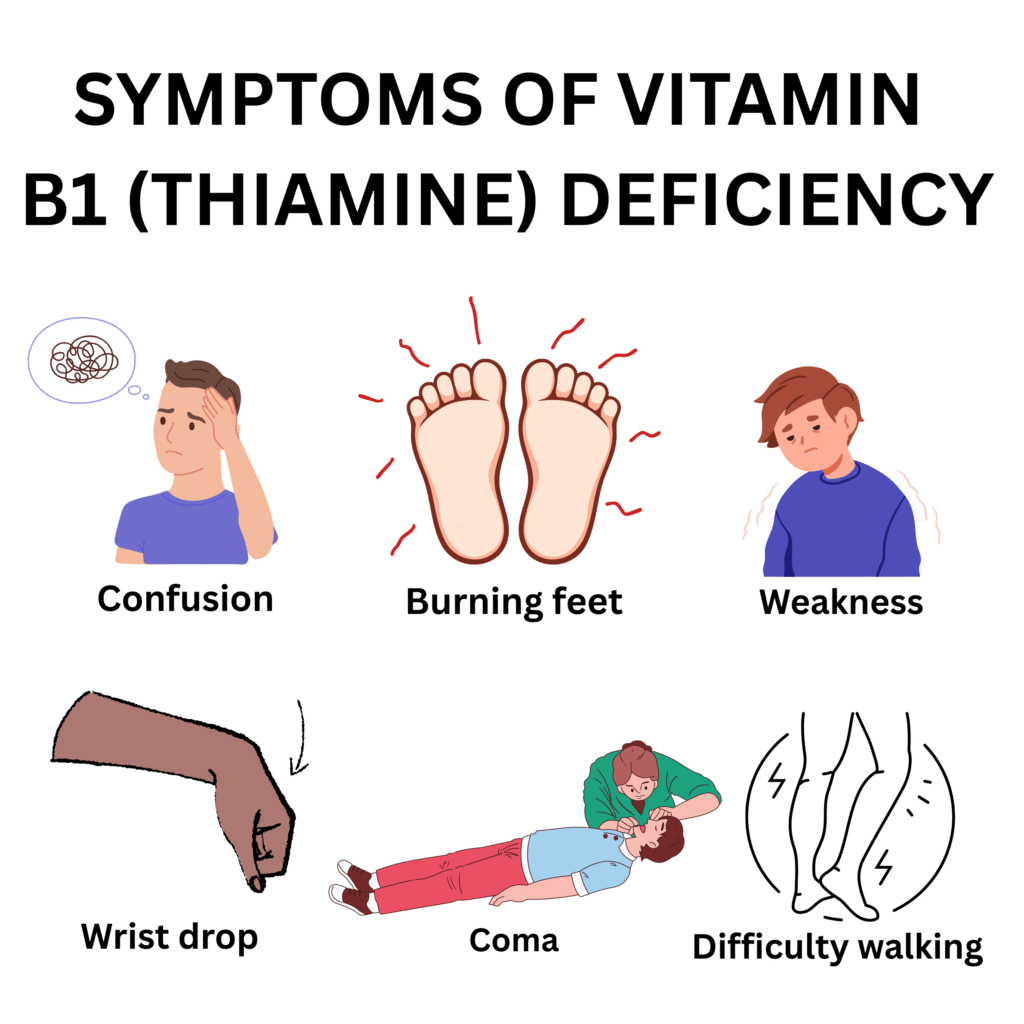
Thiamine deficiency produces three distinct clinical syndromes depending on which tissues are most affected, how severe the deficiency is, and how rapidly it develops.
The Three Clinical Syndromes
Dry beriberi — peripheral nervous system.
Wet beriberi — cardiovascular system.
Wernicke-Korsakoff syndrome — central nervous system.
All three share the same underlying biochemical failure: insufficient thiamine pyrophosphate for aerobic energy production in high-metabolic-rate tissues.
System | Dry Beriberi (Peripheral Neuropathy) | Wet Beriberi (Cardiac) | Wernicke-Korsakoff (Brain) |
Primary organ | Peripheral nerves | Heart and vasculature | Brain: mammillary bodies, thalamus, cerebellum |
Onset speed | Weeks to months | Days to weeks | Hours to days in acute form |
Hallmark feature | Ascending sensorimotor neuropathy | High-output cardiac failure | Confusion, ophthalmoplegia, ataxia |
Early symptoms | Burning feet, weakness, loss of reflexes | Palpitations, dyspnoea, ankle oedema | Disorientation, difficulty walking, eye movement abnormalities |
Severe features | Foot drop, wrist drop, total areflexia | Cardiomegaly, biventricular failure, peripheral oedema, death | Coma; death if untreated |
Reversible with thiamine? | Partially — early cases fully, late cases partially | Yes — often dramatically within 24 to 48 hours | Wernicke: partially. Korsakoff: largely irreversible |
Seen most in US/EU | Post-bariatric surgery, alcohol dependence | Alcohol dependence, prolonged illness | Alcohol use disorder in hospitalised malnourished patients |
Table 2. The three clinical syndromes of thiamine deficiency. Sources: NIH ODS; NCBI StatPearls (2025); Merck Manual; American Academy of Neurology.
Dry Beriberi — Peripheral Neuropathy
Dry beriberi is the peripheral nerve form of thiamine deficiency. It is predominantly sensorimotor and follows a length-dependent pattern — the longest nerves fail first.
Early symptoms: symmetrical burning, tingling, and aching in the feet and lower legs. Patients describe it as walking on sand or feeling as though the feet are on fire. Deep tendon reflexes at the ankles are lost early.
As deficiency progresses, muscle weakness begins in the lower limbs and ascends. Foot drop develops — the patient trips on kerbs and cannot dorsiflex the foot. Wrist drop follows in the upper limbs in severe cases.
The neuropathy of dry beriberi is strikingly similar to the peripheral neuropathy of Vitamin B12 deficiency and Vitamin B6 deficiency. All three must be considered in any patient presenting with a length-dependent sensorimotor neuropathy. Checking thiamine, B12, and B6 simultaneously in the same blood draw is the most efficient approach.
Wet Beriberi — The Cardiac Emergency
Wet beriberi is the cardiovascular form. It carries the highest acute mortality of all three syndromes.
The mechanism: thiamine deficiency impairs ATP production in peripheral vascular smooth muscle. Vasodilation occurs throughout the peripheral circulation. The heart responds by increasing cardiac output to maintain perfusion pressure.
This high-output state is initially compensatory, but the thiamine-depleted myocardium cannot sustain it. Biventricular failure develops. The patient becomes dyspnoeic, oedematous, and in extremis.
The critical diagnostic feature that distinguishes wet beriberi from standard heart failure: the elevated cardiac output. Standard heart failure produces low output. Wet beriberi produces high output.
Measuring cardiac output (elevated) alongside low or undetectable thiamine levels in a patient with heart failure who has alcohol dependence or malnutrition makes the diagnosis.
💡 Clinical Insight: Response to IV thiamine in wet beriberi is one of the most dramatic treatment responses in internal medicine. I have seen patients with moderate wet beriberi improve so rapidly within 24 to 48 hours of IV thiamine that the clinical transformation is astonishing. The cardiac output normalises. The oedema begins resolving. The breathlessness improves. When this happens, the diagnosis is confirmed by the response.
Wernicke-Korsakoff Syndrome — The Brain Emergency
This is the most dangerous and the most commonly missed consequence of thiamine deficiency.
Wernicke encephalopathy is the acute phase. It is a medical emergency. The classic triad:
- Confusion: global confusional state, disorientation, inattention, and impaired short-term memory.
- Ophthalmoplegia: paralysis of eye movements, most commonly lateral gaze palsy and nystagmus. The patient cannot move the eyes fully to one or both sides. This occurs because the nuclei of the oculomotor nerves lie in the periventricular area, which is preferentially damaged by thiamine deficiency.
- Ataxia: a wide-based, unsteady gait; difficulty walking without support; and limb coordination problems.
The critical clinical reality: only one-third of patients with Wernicke encephalopathy present with all three features simultaneously. Waiting for the complete triad before treating is waiting too long. In alcohol-dependent or malnourished patients, any one of the three features warrants immediate thiamine treatment.
Without treatment, Wernicke encephalopathy progresses to coma and death.
KORAKOFF PSYCHOSIS. With inadequate or delayed treatment, it transitions to Korsakoff psychosis — the chronic, largely irreversible amnestic phase. Korsakoff psychosis is characterised by:
- Anterograde amnesia — the inability to form new memories. The patient cannot learn new information. Each conversation is forgotten within minutes.
- Confabulation — the patient unconsciously fabricates memories to fill the gaps, not deliberately lying but generating plausible-sounding false narratives.
Relative preservation of long-term memory and intellectual function.
Korsakoff psychosis is largely irreversible. Approximately 25% of patients recover partially. The majority require long-term care. This is why prevention of Wernicke encephalopathy, and its urgent treatment when recognised, is so critical.
The window between treatable Wernicke and irreversible Korsakoff closes within days.
Infantile Beriberi
Infantile beriberi is a rapidly fatal syndrome occurring in breastfed infants of thiamine-deficient mothers. The infant appears well at birth but develops acute cardiac failure between 2 and 3 months of age.
The baby loses its cry (aphonia) and becomes dyspnoeic and, without immediate thiamine treatment, dies within hours.
This is not seen in the US and EU under normal circumstances but has been reported in immigrant communities and in cases of severe maternal dietary restriction.
What Causes Thiamine Deficiency
Cause | Mechanism | Who Is Affected in the US and EU |
Alcohol use disorder | Alcohol blocks intestinal thiamine absorption, impairs hepatic phosphorylation of thiamine to its active form TPP, increases urinary thiamine excretion, and displaces thiamine-rich foods from diet simultaneously | Approximately 29 million Americans have alcohol use disorder per SAMHSA 2023. The primary cause of thiamine deficiency in the US and EU |
Polished white rice diet without fortification | Milling removes the thiamine-rich bran and germ. White rice contains approximately 0.02 mg thiamine per half cup versus 0.10 mg in brown rice. Relevant for communities in the US and EU eating unfortified Asian staple rice | Certain immigrant communities, eating predominantly non-fortified white rice. Not relevant for populations eating US-fortified commercial white rice |
Bariatric surgery | Dramatically reduced food intake post-surgery plus vomiting prevents adequate thiamine absorption. Bypassed duodenum reduces the absorptive surface. Thiamine deficiency after bariatric surgery has caused permanent Wernicke encephalopathy in documented cases | Approximately 250,000 bariatric procedures are performed annually in the US. Thiamine monitoring and supplementation is mandatory post-operatively |
Prolonged IV dextrose without thiamine | IV glucose without thiamine supplementation in malnourished hospitalised patients depletes the last thiamine reserves by demanding TPP for pyruvate dehydrogenase activity | Any hospitalised malnourished patient receiving thiamine-free glucose infusions |
Hyperemesis gravidarum | Prolonged severe vomiting in pregnancy prevents all oral thiamine absorption. Cases of pregnancy-related Wernicke encephalopathy are documented in the US obstetric literature | Pregnant women with severe hyperemesis requiring IV antiemetics and fluids must receive IV thiamine |
Refeeding syndrome | Rapid refeeding of malnourished patients drives thiamine into cells as insulin rises with glucose loading, precipitously depleting plasma thiamine | Any severely malnourished patient being refed, including eating disorder patients. IV thiamine before refeeding is standard of care |
Anorexia nervosa | Severe dietary restriction. Body weight maintained below 15% of normal depletes thiamine stores | A well-documented cause in eating disorder patients across the US and EU. Thiamine monitoring is a standard component of eating disorder treatment |
Prolonged parenteral nutrition without thiamine | Historical cause. Modern TPN formulations include thiamine as standard. Risk in non-standard or home TPN scenarios | Patients on home TPN or non-standard supplementation |
Dialysis | Thiamine is water-soluble and removed in dialysate. Alongside B6, folate, and Vitamin C, it requires routine supplementation in dialysis patients | Part of standard renal multivitamin protocol |
Table 3. Causes of thiamine deficiency in the US and EU context. Sources: NIH ODS; NCBI StatPearls (2025); SAMHSA 2023; Merck Manual.
The Glucose-Before-Thiamine Error
This deserves its own explanation because it remains one of the most consequential preventable errors in emergency medicine.
Every hospital emergency department uses IV glucose-containing fluids routinely. Dextrose drips, 50% dextrose for hypoglycaemia, and total parenteral nutrition all deliver glucose directly into the circulation.
In a healthy person with normal thiamine stores, this is safe. The thiamine pyrophosphate needed to metabolise the glucose is available.
In a thiamine-depleted patient (anyone with alcohol dependence, malnutrition, prolonged vomiting, anorexia, or bariatric surgery) the situation is different. Their TPP stores are already critically low.
Administering a glucose load drives the demand for TPP dramatically upward. Pyruvate dehydrogenase needs TPP urgently. The last remaining thiamine is consumed by this metabolic surge. The brain is stripped of the cofactor it needed to extract energy from glucose.
The result: lactic acidosis and acute energy failure in thiamine-sensitive brain regions, particularly the mammillary bodies, thalamus, and periventricular grey matter. Wernicke encephalopathy is precipitated.
⚠️ Warning: In any patient who is malnourished, alcohol-dependent, has had bariatric surgery, has experienced prolonged vomiting, or has been on a very restricted diet, IV thiamine must be given before any glucose-containing fluid is started. Not simultaneously. Before. This rule is absolute. The thiamine ampoule costs less than a dollar. The Korsakoff syndrome it prevents is irreversible and lasts a lifetime.
Diagnosis
The diagnosis of thiamine deficiency is primarily clinical. Laboratory confirmation is useful but must never delay treatment.
Blood Tests
Erythrocyte transketolase activity (ETKA) and thiamine pyrophosphate effect (TPPE): The gold standard. Transketolase is a thiamine-dependent enzyme in red blood cells. Low activity confirms deficiency. TPPE greater than 25% after adding TPP in vitro confirms deficiency. More sensitive than plasma thiamine levels.
Whole blood thiamine: Measures total thiamine (free plus phosphorylated forms). More reliable than plasma thiamine alone. Below 70 nmol/L indicates deficiency.
Plasma thiamine: Available but less reliable. Reflects recent dietary intake rather than tissue stores. Can be normal despite significant tissue deficiency.
Lactate: Elevated lactate from impaired pyruvate dehydrogenase function. Non-specific but supports the diagnosis in the right clinical context.
Neuroimaging: MRI brain in Wernicke encephalopathy shows characteristic bilateral hyperintensities in the mammillary bodies, periventricular thalamic nuclei, and periaqueductal grey matter on T2-weighted and FLAIR sequences. A normal MRI does not exclude Wernicke encephalopathy — sensitivity is approximately 53%.
Clinical Assessment
The most important clinical rule: do not wait for laboratory results before treating. In any at-risk patient with confusion, eye movement abnormality, or ataxia, start IV thiamine immediately.
The combination of clinical history (alcohol dependence, malnutrition, bariatric surgery, prolonged vomiting) plus any neurological feature listed in the Wernicke triad is sufficient grounds for immediate IV thiamine. Waiting for blood results in this scenario causes preventable permanent brain damage.
Alongside thiamine, check magnesium — magnesium is required for the conversion of thiamine to its active TPP form. Concurrent hypomagnesaemia can blunt the response to thiamine replacement. Correct both simultaneously.
Also check Vitamin B12, folate, and zinc in alcohol-dependent patients — these deficiencies coexist in the majority.
Treatment
The treatment dose depends entirely on the clinical scenario. Prophylactic thiamine for a malnourished patient receiving glucose is a very different dose from IV thiamine for established Wernicke encephalopathy.
Clinical Scenario | Treatment | Route and Duration |
Prevention in malnourished patient receiving IV glucose | Thiamine 100 mg before the glucose infusion | IV or IM single dose before starting any glucose-containing fluid |
Suspected Wernicke encephalopathy | Thiamine 200 to 500 mg three times daily for 3 to 5 days | IV infusion over 30 minutes. Do not give as fast IV bolus (rare anaphylaxis risk). Then oral thiamine, 100 mg daily |
Established Wernicke encephalopathy with ophthalmoplegia | Thiamine 500 mg three times daily for a minimum of 5 days | IV. Higher dose justified by severity. Eye movement abnormalities often improve within 24 to 48 hours |
Alcohol dependence — prevention | Thiamine 100 mg daily orally | Oral. Continued lifelong in active drinkers. Absorption is impaired in active drinking. Parenteral route is preferred when possible. |
Post-bariatric surgery — prevention | Thiamine 50 mg daily as part of standard B-complex supplement | Oral lifelong. Annual whole blood thiamine monitoring |
Hyperemesis gravidarum | Thiamine 100 mg IV daily until vomiting resolves and oral intake resumes | IV. Before any glucose. Essential in any pregnant woman with prolonged vomiting |
Refeeding syndrome prevention | Thiamine 200 to 300 mg IV before refeeding commences | IV. Standard refeeding protocol in eating disorders and severe malnutrition |
Dry beriberi (peripheral neuropathy) | Thiamine 50 to 100 mg orally three times daily for 4 to 6 weeks | Oral. Early cases partially to fully reversible. Advanced neuropathy is only partially reversible |
Table 4. Thiamine deficiency treatment protocol. Sources: NIH ODS; NCBI StatPearls (2025); Merck Manual; Royal College of Physicians UK Alcohol Guidelines.
Recovery Timeline
What Improves | Timeline |
Ophthalmoplegia (eye movement paralysis) | 24 to 48 hours with IV thiamine — often the fastest response |
Ataxia and gait instability | Days to weeks |
Confusion in Wernicke | Days to weeks — may not fully resolve if Korsakoff is established |
Wet beriberi — cardiac improvement | 24 to 48 hours. Dramatically rapid response |
Peripheral neuropathy (dry beriberi) — early | Weeks to months |
Peripheral neuropathy — advanced | Months. Incomplete recovery in established cases |
Korsakoff psychosis | Largely irreversible. 25% partial improvement. Prevention is the only effective strategy |
Table 5. Thiamine deficiency recovery timeline. Source: Clinical experience; NCBI StatPearls (2025).
Best Food Sources of Thiamine
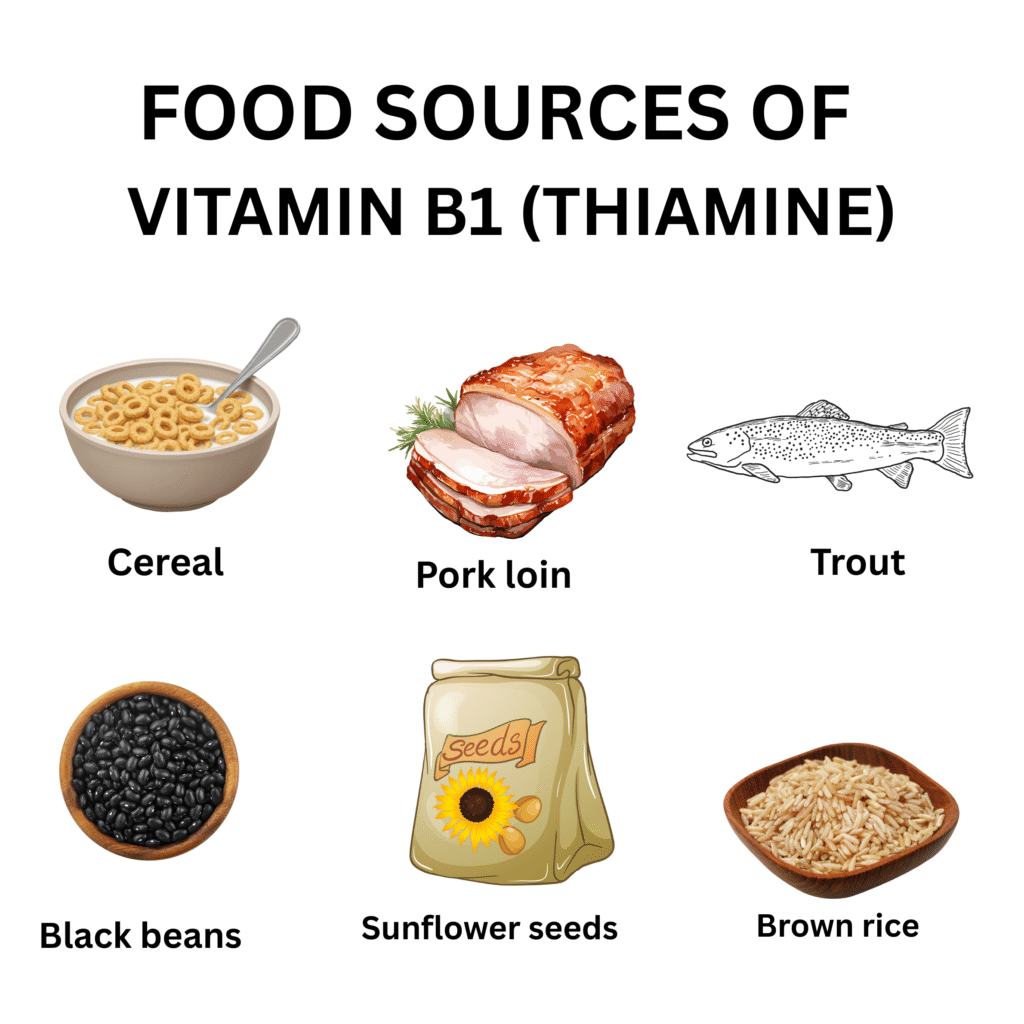
The thiamine content of food is dramatically affected by processing. Milling removes thiamine from grain. Cooking in water leaches thiamine out of vegetables. Heat destroys thiamine. Sulphites (used as food preservatives) degrade thiamine. The difference between a diet built on whole foods versus ultra-processed foods, in terms of thiamine delivery, is substantial.
Food | Serving | Thiamine (mg) | Notes |
Nutritional yeast (fortified) | 2 tablespoons | 9.6 mg | Single richest available source. |
Fortified breakfast cereal | 1 serving | 1.5 mg | Mandatory thiamine fortification in US cereals since 1943 |
Pork loin, cooked | 85 g | 0.81 mg | Single best animal source by far |
Trout, cooked | 85 g | 0.43 mg | Excellent fish source |
Black beans, cooked | Half cup | 0.42 mg | |
Sunflower seeds | 28 g | 0.41 mg | Good snack source alongside Vitamin E and selenium |
Lentils, cooked | Half cup | 0.17 mg | |
Brown rice, cooked | Half cup | 0.10 mg | Five times more than white rice |
Fortified white bread | 1 slice | 0.15 mg | US mandatory fortification |
White rice, cooked | Half cup | 0.02 mg | Almost no thiamine. Milling removes it |
Asparagus, cooked | Half cup | 0.15 mg | Good vegetable source |
Edamame | Half cup | 0.15 mg | Good plant protein and thiamine source |
Table 6. Dietary sources of thiamine. Source: NIH ODS; USDA FoodData Central. Adult RDA: men 1.2 mg, women 1.1 mg per day.
The white rice lesson: The contrast between brown rice (0.10 mg per half cup) and white rice (0.02 mg per half cup) illustrates exactly how milling destroys thiamine. Brown rice provides five times more thiamine per serving than the same quantity of polished white rice. This is why populations that switched from traditional staple grains to milled white rice without fortification historically developed beriberi epidemics.
In the US, mandatory fortification of refined grain products since 1943 has largely offset the loss from milling. The risk groups are those avoiding fortified grains.
Frequently Asked Questions About Vitamin B1 Deficiency
Related Articles on MedBeaconHub.com
- Nutritional Deficiency Diseases: The Complete Doctor’s Guide
- Vitamin B12 Deficiency: Nerve Damage and Pernicious Anaemia
- Vitamin B6 Deficiency: Depression, Neuropathy and the OCP
- Folate Deficiency: The Pregnancy-Critical B Vitamin
- Magnesium Deficiency: Sleep, Cramps and Anxiety
- Zinc Deficiency: Immunity, Taste and Wound Healing
- Vitamin D Deficiency: The Most Common US Deficiency
- Iron Deficiency Anaemia: Symptoms and Treatment
- Selenium Deficiency: The Thyroid Mineral
- Vitamin C Deficiency: Scurvy and Iron Absorption
- Calcium Deficiency: Hypocalcaemia and Bone Disease
- Vitamin B7 Biotin Deficiency: Hair Loss, FDA Warning and Treatment
- Vitamin K Deficiency: Bleeding and Warfarin
References and Authoritative Sources
- NIH Office of Dietary Supplements — Thiamine Fact Sheet for Health Professionals
- NCBI StatPearls — Thiamine Deficiency (Updated 2025)
- Merck Manual Professional Edition — Thiamine Deficiency
- Cleveland Clinic — Wernicke-Korsakoff Syndrome
- SAMHSA — 2023 National Survey on Drug Use and Health — Alcohol Use Disorder Data
- American Academy of Neurology — Thiamine in Alcohol Use Disorder: AAN Guideline Summary (2024)
- WHO — Thiamine Deficiency and Its Prevention
- PMC — Wernicke Encephalopathy: New Clinical Settings and Recent Advances (2024)
- PMC — Thiamine Deficiency After Bariatric Surgery: A Systematic Review (2024)
- Alcoholism Clinical and Experimental Research — Prevalence of Wernicke’s Encephalopathy in Autopsy Studies (2013)